Wednesday, March 23, 2011
Counterfeit "Heaven" stories still interest people. Here's a link back to that topic.
Monday, March 21, 2011
God's Sovereignty in Catastrophes: Who's Ruling This Planet Anyway?
But as soon as you try to say something along those lines you find yourself pounced on by people who consider you the most hateful evil person who ever lived. The language used is pretty excoriating. They denounce and blaspheme and rail in tones of most aggrieved indignation. You think you're just saying something simple and true that is based on biblical scripture, something in fact that is God-honoring and even conducive to spiritual growth, but no, to hear them go on it appears you're guilty of something on the order of genocide, at the very least an unChristian "judgmentalness." A W Pink's The Sovereignty of God written in 1918 is the classic on the subject. From his Introduction:
It would be foolish for us to expect that this work will meet with general approval. The trend of modern theology—if theology it can be called—is ever toward the deification of the creature rather than the glorification of the Creator, and the leaven of present-day Rationalism is rapidly permeating the whole of Christendom. The malevolent effects of Darwinianism are more far reaching than most are aware. Many of those among our religious leaders who are still regarded as orthodox would, we fear, be found to be very heterodox if they were weighed in the balances of the Sanctuary. Even those who are clear, intellectually, upon other truth, are rarely sound in doctrine. Few, very few, today, really believe in the complete ruin and total depravity of man. Those who speak of man’s "free will," and insist upon his inherent power to either accept or reject the Saviour, do but voice their ignorance of the real condition of Adam’s fallen children. And if there are few who believe that, so far as he is concerned, the condition of the sinner is entirely hopeless, there are fewer still who really believe in the absolute Sovereignty of God.From his Chapter One:
To say that God is sovereign is to declare that He is the Almighty, the Possessor of all power in heaven and earth, so that none can defeat His counsels, thwart His purpose, or resist His will (Ps. 115:3). To say that God is sovereign is to declare that He is "The Governor among the nations" (Ps. 22:28), setting up kingdoms, overthrowing empires, and determining the course of dynasties as pleaseth Him best. To say that God is sovereign is to declare that He is the "Only Potentate, the King of kings, and Lord of lords" (1 Tim. 6:15). Such is the God of the Bible. How different is the God of the Bible from the God of modern Christendom! The conception of Deity which prevails most widely today, even among those who profess to give heed to the Scriptures, is a miserable caricature, a blasphemous travesty of the Truth. The God of the twentieth century is a helpless, effeminate being who commands the respect of no really thoughtful man. The God of the popular mind is the creation of a maudlin sentimentality. The God of many a present-day pulpit is an object of pity rather than of awe-inspiring reverence.[1] To say that God the Father has purposed the salvation of all mankind, that God the Son died with the express intention of saving the whole human race, and that God the Holy Spirit is now seeking to win the world to Christ; when, as a matter of common observation, it is apparent that the great majority of our fellow-men are dying in sin, and passing into a hopeless eternity: is to say that God the Father is disappointed, that God the Son is dissatisfied, and that God the Holy Spirit is defeated. We have stated the issue baldly, but there is no escaping the conclusion. To argue that God is "trying His best" to save all mankind, but that the majority of men will not let Him save them, is to insist that the will of the Creator is impotent, and that the will of the creature is omnipotent. To throw the blame, as many do, upon the Devil, does not remove the difficulty, for if Satan is defeating the purpose of God, then, Satan is Almighty and God is no longer the Supreme Being. To declare that the Creator’s original plan has been frustrated by sin, is to dethrone God. To suggest that God was taken by surprise in Eden and that He is now attempting to remedy an unforeseen calamity, is to degrade the Most High to the level of a finite, erring mortal. To argue that man is a free moral agent and the determiner of his own destiny, and that therefore he has the power to checkmate his Maker, is to strip God of the attribute of Omnipotence. To say that the creature has burst the hounds assigned by his Creator, and that God is now practically a helpless Spectator before the sin and suffering entailed by Adam’s fall, is to repudiate the express declaration of Holy Writ, namely, "Surely the wrath of man shall praise Thee: the remainder of wrath shalt Thou restrain" (Ps. 76:10). In a word, to deny the sovereignty of God is to enter upon a path which, if followed to its logical terminus, is to arrive at blank atheism. The sovereignty of the God of Scripture is absolute, irresistible, infinite. When we say that God is sovereign we affirm His right to govern the universe, which He has made for His own glory, just as He pleases. We affirm that His right is the right of the Potter over the clay, i.e., that He may mould that clay into whatsoever form He chooses, fashioning out of the same lump one vessel unto honor and another unto dishonor. We affirm that He is under no rule or law outside of His own will and nature, that God is a law unto Himself, and that He is under no obligation to give an account of His matters to any.From The God of Disasters by Vincent Cheung:
... Many people's belief systems are not equipped to handle catastrophes, and so to them they appear random, senseless, and beyond explanation. Some people resort to pragmatism, focusing on picking up the pieces; others are driven to cynicism and despair. But whether or not they come up with their own explanations, or whether their explanations agree with one another, they are united in condemning those who would say that these catastrophes are God's punishments against sinners – those who worship idols, blaspheme, murder, fornicate, cheat, oppress, those who are lovers of themselves rather than lovers of God, and those who would expel him from their courts and schools and families. No, it is not that they can prove these people's innocence, or that they can prove that God does not punish, but the mere suggestion that God would visit them with judgment, and in wars, and floods, and fires that at times would kill thousands, is enough to invite their anathema. Anyone who dares to suggest that a disaster could be God's legitimate recompense upon deserving evildoers is reviled as cruel, unpatriotic, or the like. It is noteworthy that these individuals ... include both non-Christians and professing Christians. ...as long as we stay within what is revealed in Scripture, it is possible for us to arrive at some general interpretations of what God is doing in the world and in our lives. Scripture tells us that God does punish sinners with both natural and "man-made" disasters, from the everyday mishaps and inconveniences to things like floods, earthquakes, plagues, famines, blizzards, and so on. All these things occur by God's sovereign decree and power. Some of these things involve human decisions and actions, and so we distinguish between natural and "man-made" disasters. ...God controls both nature and man, so that even these so-called "manmade" disasters are planned and caused by God. These would include things like wars, terrorism, and genocide. ...The point is that God is the direct sovereign and righteous cause of all disasters of all kinds. [W]e have warrant from Scripture to say that when disasters like hurricanes, tsunamis, and even terrorist attacks occur, killing thousands of people, there is almost always an element of divine punishment. ... If you reject this, you might as well stop calling yourself a Christian, for your faith rests in yourself and your own opinions, and it is evident that you have no regard for God and Scripture. Then, another intended effect of these disasters is to awaken the elect and to harden the reprobates.From The Sovereignty of God Amidst Disaster, at The Veritas Network. author Ryan Rindels:
Atheists, skeptics, and agnostics [and many who call themselves Christians as well I must add] will conclude that God has nothing to do with what occurs in the natural world. Everything, from tsunamis to tornadoes, is simply the accidental phenomenon of our planet. The recent earthquake in Japan was nothing more than a seismic burp–a release of tectonic pressure that just happened upon a populated area. Was there any purpose or intent in the death of thousands? Honestly, no. Wrong place, wrong time. Random chance. Sorry, that’s the best conclusion they can give you. ...We believe every single event, however apparently random and accidental, is part of God’s sovereign plan. Nothing is accidental, nothing happens by chance. Even those things that seem bad and harmful are pieces of a greater puzzle which we cannot see or understand. God exists to glorify himself. He is just and right and worthy to do this. In the book of Job we learn that God isn’t obligated to reveal his divine will to us. Could we even comprehend it if he did? Faith in him is sufficient.I also agree with this one from a blog called Ardent Cries, author Chad Bennett:
People who die in these disasters are not being judged for being worse than you and I. What judgment has fallen, we all deserve.It IS God's judgment but we all deserve judgment. As I understand it from scripture, it's a matter of timing, the "fullness of time" that determines when and to what extent God brings judgment against a particular nation. Here’s another thought on the same theme written in 1983 by John Piper:
The soft-hearted rebels exploit heartache to push their heresy: the death of a daughter, a Down’s syndrome son, a freak accident, a husband’s cancer—is God a sadist? And so the rebels find broken hearts and pour their heresy in the cracks. But it is not healing. Only truth can heal. It need not be spoken callously. It need not be spoken at all in moments of anguish. But it must be believed and cherished. “He does according to his will in the host of heaven and among the inhabitants of the earth and none can stay his hand or say to him, ‘What doest thou?’” (Daniel 4:35). ...Psalm 105:16 says, “He summoned a famine on the land, and broke every staff of bread.” When I read this I simply bowed in awe of the God who orders from his throne all wind and heat and rain.As should we all. (Great line by the way, The soft hearted rebels exploit heartache...) And here is John Piper again , quoted in a blog post on the devastation of Haiti (which has other good quotes and comments, including about Tony Campolo denying that God had anything to do with the disaster.) Piper is writing in the context of the Katrina disaster:
On his 89th birthday (August 31) NPR Senior News Analyst, Daniel Schorr, observed that President Bush had “staked out a non-position” on the debate between evolution and intelligent design. Bush had said that “both sides ought to be properly taught in the schools of America.” Then, with manifest scorn, Schorr linked the devastation of Hurricane Katrina with the concept of intelligent design: “[Bush] might well have reflected that, if this was the result of intelligent design, then the designer has something to answer for.” No, Mr. Schorr, you have something to answer for, not God. God answers to no man. Come, Daniel Schorr, take your place with Job and answer your Maker: “The Lord answered Job [and Daniel Schorr] out of the whirlwind and said: ‘Who is this that darkens counsel by words without knowledge? Dress for action like a man; I will question you, and you make it known to me. . . . Who shut in the sea with doors when it burst out from the womb, when I made clouds its garment and thick darkness its swaddling band, and prescribed limits for it and set bars and doors, and said, “Thus far shall you come, and no farther, and here shall your proud waves be stayed”?’” (Job 38:1-3, 8-11). Who are you, O man, to answer back to God? Shall the pot say to the Potter, “This is an unintelligent way to show your justice and your power? Come, Maker of heaven and earth, sit at my feet—I have lived 89 years and have gotten much wisdom—and I will teach you—the eternal God—how to govern the universe”? No. Rather let us put our hands on our mouths and weep both for the perishing and for ourselves who will soon follow. Whatever judgment has fallen, it is we who deserve it—all of us. And whatever mercy is mingled with judgment in New Orleans neither we nor they deserve. God sent Jesus Christ into the world to save sinners. He did not suffer massive shame and pain because Americans are pretty good people. The magnitude of Christ’s suffering is owing to how deeply we deserve Katrina—all of us. Our guilt in the face of Katrina is not that we can’t see the intelligence in God’s design, but that we can’t see arrogance in our own heart. God will always be guilty of high crimes for those who think they’ve never committed any. But God commits no crimes when he brings famine, flood, and pestilence on the earth. “Does disaster come to a city, unless the Lord has done it?” (Amos 3:6). The answer of the prophet is no. God’s own testimony is the same: “I form light and create darkness, I make well-being and create calamity, I am the Lord, who does all these things” (Isaiah 45:7). And if we ask, is there intelligent design in it all, the Bible answers: “You meant evil . . . but God meant it [designed it] for good” (Genesis 50:20). This will always be ludicrous to those who put the life of man above the glory of God.
Friday, March 18, 2011
Radiation Threat Overblown?
(Reuters) Kazuko Yamashita was five when the atom bomb was dropped on Nagasaki, destroying her home in a second and leaving her with a lifelong fear that every time she becomes ill, this time it is finally cancer.I am pre-diabetic and have the thyroid condition called Hashimoto's, and the reason I had my thyroid checked was because I was exposed to radiation as a child. It's hard to know if there is a connection, however. I transcribe medical notes and have the impression that many people around my age (69 next month) have these conditions. A sedentary life while continuing to eat as if we lived the way our very active great grandparents lived accounts easily enough for diabetes, and I don't know the explanation for thyroid problems but they seem to be fairly common in the medical reports of people in my age range quite apart from exposure to radiation.
Now, 66 years later, she wears a dark pink sweater, her dyed hair in a neat bob, and waits out Japan's current nuclear crisis in her daughter's Tokyo home, a two-storey house she also shares with her two granddaughters who play on a sofa behind her.
"I may be a bit too callous about this due to the fact that I was really heavily exposed to radiation, but I don't think this is anything to turn pale over," she told Reuters.
"People seem to be much too sensitive, though of course it's not really for me to say, and heavy radiation exposure is a serious thing. But I was 3.6 km (2.2 miles) from the bomb, and they've evacuated for 20 km (around the stricken nuclear plant). I really don't understand this kind of feeling."
Almost a week since massive earthquake and tsunami triggered the crisis at the Fukushima Daiichi power plant, 240 km north of Tokyo, many foreigners and tourists have fled the country and rolling blackouts and radiation fears have gripped the capital.
Yamashita says she is not taking the situation lightly, even if she laments conflicting, overly alarmist news coverage.
...Yamashita suffers from diabetes, thyroid issues and osteoporosis, which she attributes to the atom bomb that fell on her native city at the end of World War Two.
I grew up in Nevada a couple hundred miles from the Yucca Flats bomb tests in the fifties, certainly much farther away than Kazuko Yamashita from the Nagasaki bomb. I remember my grade school class being taken to a hill outside of town to get a good view of one of the bombs, probably the first one in 1951. We were told to cover our eyes for the flash and then we could look to see the mushroom cloud. I don't know when anxiety about radiation took hold but eventually there was at least as much fear as eagerness to watch the bombs.
As the tests went on over the years we began to get three-and-four-yolked eggs from chickens in the fallout zone. We merely marveled at them, had no problem eating them. A truck load of cattle came through once in which the animals were clearly suffering from radiation sickness, could hardly stand up, some even sloughing their hides. My father told us to stay away from the truck, but my brother couldn't resist getting closer and he's the one who remembers all that. He remembers the truck driver poking them with electrified prods to make them stand up to keep them alive long enough to sell them for meat, not wanting to lose a sale. I have to suppose they came from an area much closer to the test site. I have no idea what the effect of eating that meat might have been. The truck eventually went on through town so who knows who ended up with the meat if anybody did buy it.
But there was also fallout all over the desert surrounding our town, enough to register on geiger counters at least, although we weren't in the known path of fallout. For a while there were fortune hunters in town carrying geiger counters, thinking they had found uranium. Some had even staked "claims" to some supposed lode or other out in the desert. That all came to a sudden end when it became generally known that they were only detecting fallout.
So apparently I was exposed to some degree of radiation during those years, yet as far as I know I can't attribute any medical problems to it. My brother and sister have no problems whatever that could be attributed to it. There was one case of leukemia in our town in those years and that might have been the result of the tests, but there's no way to know. It was only one case.
So I agree with Mrs. Yamashita that the problems they are having with the nuclear power plants aren't as big a deal as some are making them out to be. Of course radiation IS serious and radiation CAN kill people, but this scare is out of proportion for anyone miles from the plants. She was only two miles from the Nagasaki bomb, I was a couple hundred miles from dozens of bomb tests in Nevada, California is across an ocean from Japan. The worries are overblown. They once said radiation could poison an area for thousands of years, but now Hiroshima and Nagasaki are both thriving cities.
Not to play it down, just to try to find a realistic level of concern.
===================
OOPS. Update, April 15:
Talked to my brother. Conversation rambled from the longevity -- or lack of it -- of various family members to smokers in the family to his saying that the chronic cough we all knew he had as a teenager, that a doctor later told him was from TB, wasn't from TB at all, as another doctor told him after that. He had no signs of ever having had TB, but he had had a ferocious cough that prevented him from participating in PE in high school. I never knew that. We weren't a very communicative family in those days. And it lasted into his twenties, compounded of course by his being a smoker in those years. But that kind of persistent cough he found out is a common symptom of radiation sickness. It lasted from about age 10 into his early 20s and then went away completely. No cancer, in fact no diagnosis at all, just the cough, a very heavy cough.
So I have to change my statement that my brother and sister have shown no symptoms of having been affected by the bomb tests. He was exposed more than any of the rest of us, because he liked to go with our father whenever he drove any distance out into the desert as part of his job. Whether our father was affected or not I don't know. Both our parents died relatively young - in their sixties -- of heart problems.
Now I'll have to ask my sister if she's ever had any symptoms she attributes to the bomb tests.
Thursday, March 17, 2011
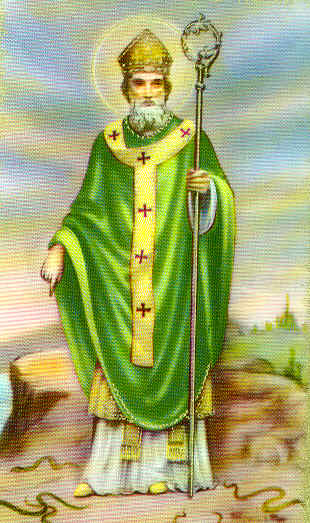
St. Patrick's Day
Since I did a pretty good job on St. Patrick's Day a couple years ago with a post on a book about the man, I'm going to leave well enough alone and just link back to that.But another thing: I ran across the phrase "the luck of the Irish" today and although I'd never given it any thought before, it suddenly hit me as odd that the Irish would be known for good luck, so I wondered if that was originally an ironic remark referring to their BAD luck. Looked it up and turned out my suspicion was right. Funny how things can get so completely turned around backwards.
But they had some good luck at least on the day Patrick came to them bringing the gospel of Christ.
And OK, I do feel obliged to mention that Patrick was NOT a Roman Catholic! I said that in the other post but I have to say it again. He belonged to the Celtic church in England in the 5th century, which preceded the takeover by the Roman Church. He was a bishop in that church which was nothing like being a bishop in the Roman Church, and as an evangelist he and his missionary friends lived in extremely rough conditions. He never wore anything like that ridiculous costume of robes and pointed fish-head thing on his head he's now shown as wearing.
Sunday, February 27, 2011
A Chance to Die*
I just saw a movie on Netflix, Brothers with Tobey Maguire, Jake Gyllenhaal, Natalie Portman, Sam Shepard, made in 2009. Good cast, good acting, touching story, believable. It's an American remake of a Danish film done a few years earlier. I have that one up next to watch in my Netflix queue. It occurred to me I should wait until I've seen it to write anything, but after reading the reviews I don't think I need to. I gather the main incident in the American version doesn't occur in the Danish version and that incident is what I want to comment on. It's the "explanation" offered by the American version for the mental breakdown of a soldier returned from war, and apparently no explanation was needed in the Danish version to make the story of his breakdown believable. I'm sure that's so. There are plenty of things war can do to people to tear them apart psychologically, making any particular explanation unnecessary. (Tue Mar 1: I did see the Danish version last night and it's exactly the same story, and the same incident IS at the center of it).
This incident got hold of me and I can't stop thinking about it completely apart from the fabric of the film.
Maguire plays an American marine in Afghanistan whose helicopter is shot down and he's reported to his family as dead. But he survives and is taken POW. After enduring months of imprisonment in a cave with another soldier he is made to kill that soldier, a friend. He's told it's either him or the friend, either getting to see his family again or dying. At first he throws down the pipe they've given him to use against his friend, but then they threaten him again with a gun to his head and he ends up using the pipe to beat his friend to death. Eventually he's freed and goes home only to find he can't adjust, has paranoid thoughts about his wife and his brother being together during the months they thought he was dead, is tense, depressed and angry, unable to get back into the old life. This is not an uncommon story for returning soldiers, but in this case the explanation is his guilt for having given in and killed his friend.
Here's why I wanted to write about this: The family are portrayed as Christians, at least they are shown together in church for the funeral of this marine, singing a hymn that is apparently familiar to them.
I can't help thinking what a Christian witness it would have been if the marine had stuck it out to the end as a disciple of Christ, on the Christian principle, Greater love hath no man than this, that he lay down his life for his friends. This is what Jesus did for His friends, and since the servant is not greater than the master it may be asked of His followers as well. At the very least, of course, Thou shalt not murder is a clear enough directive for a Christian, and to obey it under that kind of duress would also show great faith, but to lay down your life because Jesus did, with that much faith in Him, would be powerful witness to his torturers. THIS is the witness that brought people to Christ when the Christians were under severe persecution in the Roman Empire, the faith that is shown through the willingness to die. Which is all the more powerful a witness if the love of Christ for the torturers shines through.
I have in mind Tertullian's famous line, The blood of the martyrs is the seed of the church and the article at this website, Reformation Theology, says it very well:
We have no trouble thinking of persecution and martyrdom as a great obstacle to the spread of the gospel which will not, however, be successful in hindering Church growth. We would have no problem affirming that the blood of the martyrs is a hurdle which, by God’s grace, can be overcome. But to say that the blood of the martyrs is the seed of the Church is an altogether different concept. If martyrdom is a surmountable obstacle to the growth of the Church, then the Church might advance just as well, even better, without it. But if the blood of the martyrs truly is the seed of the Church, then without it, the Church does not grow. Without martyrdom, the Church would never have taken root in the world of Tertullian. Without martyrdom, the Church would not have spread to the Auca Indians in South America, or to China or Burma or the islands of the South Seas. The blood of the martyrs is a necessary means for the worldwide application of Christ’s great redemptive accomplishment. This is the full force of Tertullian’s insight ...
Without the martyrdom of Stephen, forgiving those who were stoning him to death, while the young Saul of Tarsus looked on, the church of Christ might never have been born, would never have spread as it did in those early days.
And that is the perfection of Christian testimony down the centuries. Josef Tson comes to mind, the Romanian pastor during the reign of Ceaucescu who was able to love his interrogator who beat him, who was able to overcome his distress when the police confiscated his valuable library, to the extent of remembering to be a good host and offer them coffee. Tson also wrote a book about the importance of martyrdom which I have yet to read. It is good to read stories like Tson's (or hear him speak -- a number of his talks are at You Tube or maybe Google video), like Foxe's Book of Martyrs, the story of John Bunyan in prison having to commit his wife and children to the care of God rather than give in to the demands of the authorities which would have set him free, or many of the little books you can find about various missionaries and other Christians around the world. The Russian woman's prayer for God to forgive the young KGB thug who was about to club her over the head was the beginning of his salvation (read about it in the little book The Persecutor).
And remember, the word martyr is a Greek word that means "witness." What we think of as witnessing is a pretty pale reflection of the original meaning in Christian history.
I love those stories, they ring true in a way that makes so much of today's comfortable Christianity ring dull and flat if not outright false. But who am I to talk of this? I grumble over inconveniences in my own life, grumble over my aches and pains, grumble over insensitive neighbors, grumble at insults I get on the internet. I'm not laying down my life for anyone. All I can say for myself is that I catch myself at it and make resolutions to do better, to love my enemies and so on. I can also say for myself that I have this knowledge at least -- I know that this Christian life I fall so short of really IS as demanding as to ask that we lay down our lives, AND I know from experience that when I have done that, on those rare occasions, too many of them long ago by now, THEN I HAVE SEEN GOD MOVE as a result in ways that would not have happened otherwise. I mean the "little" layings-down of life as in take up your cross and follow Me, as in hate even your own life for His sake, I mean as in counting others as more worthy than yourself, as in Verily, verily, I say unto you, Except a grain of wheat fall into the ground and die, it abides alone: but if it die, it brings forth much fruit. Doing these things in the power of the Holy Spirit does bear fruit. But you have to FEEL it kill you or it's just a sham, it has to be HARD to do, it has to HURT, it has to COST. When you bear the cost willingly THEN it bears fruit. Fruit in deepening of your own spiritual life at least, but also fruit in effect on others.
So I'm preaching to myself first of all, I REALLY need to be reminded of this.
The willingness to die for your friend doesn't necessarily mean you WILL die, it's the willingness that makes the difference spiritually. The marine might yet have come home, God might have intervened in a miraculous way for both him and his friend, or both might have died. To die for the sake of Christ rather than hurt your friend would nevertheless have to be a powerful witness to the Afghans torturing them and standing around watching. There could have been a young Paul in the gathering, just as there was when Stephen was stoned to death calling for the forgiveness of his persecutors. Think of THAT fruit. However understandable the marine's reaction in the movie, think of what was lost by it if he was a Christian acting in the flesh instead of trusting in Christ.
Of course the movie wasn't a Christian movie, it was all about a mental breakdown that wouldn't have happened under the scenario I'm imagining. Mustn't forget, however, also to point out that the guilt-ridden marine himself needs Christ. At the end of the movie he is wondering if he can ever live again, and the only REAL answer is Yes, through Christ, Christ the forgiver of sin, Christ the redeemer of humanity. His guilt is exactly the burden Christ promises to relieve -- Matt 11:28: Come unto me, all you that labor and are heavy laden, and I will give you rest.
Last thought: Most movies are of course stories about fallen humanity. I often have the thought while watching a movie how differently things would have turned out if a certain character had been a believer.
-----------------------------------------------------------------
* My post title, A Chance to Die, is the title of a book by Amy Carmichael, who began her dying for Christ as a young Irish woman by moving across the world to India where she spent her life rescuing girls from temple prostitution and bringing them up in a Christian environment.

Thursday, January 27, 2011
"Heaven" stories again
It's from another "Anonymous" commenter:
I am so glad you have the guts to post about this. There is such a need. You are like the voice of one crying in the wilderness...and very unpopular in mainstream Christianity I fear.Exactly, Anonymous. A little uncomfortable with the "voice crying in the wilderness" expression but it's unfortunately true that there seem to be comparatively few calling out these things while the majority are taken in by them.
I just read the 1st chapter of the book about Alex Malarkey. While I do believe this family is very sincere, I also believe they have been deceived. As one who has recently left the charismatic movement where experiences and "manifestations" are weighted heaver than digging deeply into God's Word, I can understand how this happens. I found conflictual evidence to the Bible, albeit very subtle in the reading of the first chapter.
We as modern Christians are sorely lacking in Biblical/scriptural knowledge and it shows. We are emotional creatures; our flesh is ALWAYS needing attention and we are infested with sin. The devil knows this and he is a master at deceit...we tend to put too much value in ourselves in being discerning (pride) when in fact we should have our eyes on the LORD at all times. Why else would the LORD tell us to pray without ceasing? He knows this and that we are like (dumb) sheep gone astray.
There are many, many stories like this. It is so easy to get emotionally wrapped up and embrace them (human sentimentality & flesh) instead of doing the "mundane" work of being a "biblical archeologist" and making a stand for what God has revealed to us in His Word.
Furthermore, there should be no shame in defending the faith "as it was delivered" to us and calling out heresy. We are too worried about offending others and we should be more worried about offending God!
And thanks for the observation that this kind of gullibility does seem to be the influence of charismatic theology.
Sincerity isn't enough, there are sincere believers in all kinds of error.
And thank you again for posting a comment here.
Saturday, January 15, 2011
The Philosophical Undoing of America and How the Sixties Nearly Undid Me
Brannon Howse is new to me. Discovered him through Jan Markell's site, and she's also new to me. I forget what took me to his site this morning, but was spending some time there glancing over this and that and found this book, Grave Influence, a book I thought I probably really should have.
Of course I often think that about books and don't buy them anyway, mostly because I can't afford them. Right now I have a little extra money though...
Anyway, this book is all about the thinkers of the past he considers to have been major instruments in the making of America's current philosophical debacle, and it's a great list. Most of them I'd put on a list of my own if I made one. Only a few of them I don't know anything or much about, and I might exchange a few for others or at least add some new names, but overall I have to say that just as it stands it's quite a good list. I think I can justify buying it as an essential reference book.
Its subtitle is 21 Radicals and Their Worldviews that Rule America from the Grave
This is it, the one book you need to read if you want to understand the big picture, connect all the dots, and understand current times, and future events and trends that will be unfolding. This ground-breaking book by best-selling author Brannon Howse is the result of thousands of hours of research over many years and is must reading for every teenager and adult.Saul Alinsky, Karl Marx, John Dewey, John Maynard Keynes, Aldous Huxley, Charles Darwin, Friedrich Nietzsche, Margaret Sanger, William James, Alice Bailey, Helen Schucman, Sigmund Freud, Alfred Kinsey, Benjamin Bloom, B.F. Skinner, The Frankfurt School, Soren Kierkegaard, Julius Wellhausen, Christopher Columbus Langdell, Betty Friedan and Roger Baldwin
Brannon reveals how the worldviews of 21 dead people are still influencing every aspect of American life and vying for the hearts and minds of adults and students. Whether we are discussing, law, science, economics, history, family, social issues, education or religion, the people and worldviews seeking to further their agenda in these disciplines are almost always connected back to four major forces. Brannon reveals the connection between occultism/pagan spirituality, the apostate church, the educational establishment and government/corporations.
Through this book you will come to understand the oppositions worldview, heroes, goals, strategies, masking terms, networks and targets. Those who share the worldviews of these 21 enemies of our constitutional republic and Biblical worldview do not want their agenda and its consequences to be revealed to the American people. Above all, they do not want us to equip and train our children and grandchildren with a Biblical worldview by which to recognize, reject, and fight against their seductive and destructive lies. This book will equip you to do just that as Brannon gives specific and pro-active responses you can take to make this the finest hour for the American church.
Here is the list of twenty-one for which Brannon has dug up worldview facts you must know and prepare to oppose:
Saul Alinsky,
Karl Marx,
John Dewey,
John Maynard Keynes,
Aldous Huxley,
Charles Darwin,
Friedrich Nietzsche,
Margaret Sanger,
William James,
Alice Bailey,
Helen Schucman,
Sigmund Freud,
Alfred Kinsey,
Benjamin Bloom,
B.F. Skinner,
The Frankfurt School,
Soren Kierkegaard,
Julius Wellhausen,
Christopher Columbus Langdell,
Betty Friedan and
Roger Baldwin
Topics covered include:
Corporate fascism, sustainable development, the Third Way, global governance, dialectic process, the Delphi technique, the Cloward-Piven Strategy and deliberate chaos, community organizing, Fabian socialism, the federal reserve and a fiat currency, America's decline is Europe's gain, cultural Marxism, government mandated youth service, legal positivism, postmodernism, soft-despotism, higher-criticism, pagan spirituality, feminism, welfare-state capitalism, the false-dominate church, the Emergent Church, the spiritual battle for America, the United Nations and occultism, unmasking the one-world religion, the deconstructionists in the culture and in the church, psychological labeling of dissenters, behavior modification, a planned economy, the assault on parental authority, the two tracks to globalism, Keynesian economics, collectivism, similarities between America and Nazi Germany, national leaders are a reflection of the people, social justice, why the culture war is lost if the church goes weak, is God judging America?, When and why does God judge a nation?, the environmentalist/globalist connection, cultural revolution/sexual revolution, the right to die becomes the duty to die, the true purpose of the law, why the State wants the children, are we all God's children? And much, much more.
I first got wind of the Frankfurt School's destructive influence perhaps fifteen years ago, found out how their influence was very big -- pervasive -- and very destructive. Their ideas were part of the air you breathed in a college town in the sixties but at that time I hadn't known the source of those ideas, which are considered to be the underpinnings of Political Correctness. I followed reading up on them with some reading up on Roger Baldwin who founded the ACLU, then John Dewey. I already knew Marx, Darwin, Nietzsche, Sanger and Freud had made influential undesirable input. I still don't know much economic theory, so Keynes isn't on my own list yet. I didn't know Huxley or Alice Bailey had any particular influence on the culture, or B.F. Skinner, much as I despised his thinking back when it was big. Betty Friedan got her licks in for sure but I never thought of her as a big mover and shaker. So I guess I'll learn a few things from this book -- or disagree on a few things, probably both. In any case such a book is needed.
Funny, I already knew I wanted off this planet by the end of the sixties, when I was still a child of that generation and had no critical perspective to speak of on any of it, no coherent critical perspective anyway though the whole thing had disturbed me in some deep all-embracing way. I'd been part of it up to a point but profoundly alienated from it at the same time. It's hard to be coherent about it now because it wasn't clear in my mind then, but the feeling of distress it engendered in me returns when I think about it at all. In fact, thinking about it now I wonder how I remained at all sane through it.
The sixties is when it all started coming together for the sea change we've been living in ever since. There was something brewing I hated, the philosophical and political atmosphere was poison, but I didn't have any clear names for it then. There was no way to talk about it really either, except to describe the brooding gloomy feelings and the inchoate sense of being at odds with a nightmare world, because instead of gaining coherence by the talking it would be turned into a personal problem of your own, the focus would shift away from the real problem of a world gone loony onto your own problems of adjustment.
I wasn't a Christian until much later, and then Oh eternal gratitude to Thee, Lord, the sun of Reality and Truth broke through. (It just occurred to me now that one reason I never had a strong sense of myself as a sinner saved by grace is that I had SUCH a strong sense of having been saved from this poisonous world. Oh I know I'm a sinner and salvation is from my sins but that other salvation is probably going to dominate me until I see the Lord).
Back in those days B.F. Skinner might have been the only one I could have pointed to as the purveyer of a poisonous doctrine and I hated his stuff with a passion. One thing I knew I knew was that human beings aren't animals or automatons who get "conditioned" mechanistically and unconsciously -- or "programmed" to use probably the more current metaphor.
I didn't like a lot of what Freud had said either but wasn't able to criticize him clearly. I thought evolution was true, had read Darwin, accepted it but did have questions about how to prove his stuff that came up from time to time. I read Friedan but thought most feminism was silly. Not so much pernicious as just addlebrained -- because the earlier feminists HAD won the major battles. Some of the new feminists were deadly serious and even scary. (To be fair, I do think that although by the 60s the major injustices that had provoked the first wave of feminists had been overcome, there still was a patronizing belittling attitude toward women that did rankle and still needed to be dealt with, but nothing that could justify the Marxism-based rhetoric and results of the movement that followed).
It was all quite depressing to me, that decade where we were all supposed to be happy flower children. I wonder if I'm the only one who experienced it as I did, with that inarticulate alienation. It seems that either you hated it and knew why or loved it and knew why. I hated it but in some sense didn't know it, just "went with the flow" at least outwardly, or to the extent I did know it I struggled to understand why. It was hard to get a grip on it at least partly because I was surrounded by people who thought we were living through this wonderful change for the better. All the old musty morals and values were being challenged and brought down, you see, and a new dawn of humanistic possibilities was emerging right before our eyes. I assume everyone on that list of Brannon Howse's contributed to this wondrous new formulation of human potential in one way or another, it's the point of his book. (Just the term "human potential" brings many more names flooding to mind but I'll leave that for another pondering.)
I'm not sure I'd have done a lot better among people who hated the time and knew why, though, because I don't think they'd have had the right terms for what was really bothering me about it. (I now realize that must be because for them the problem was predominantly political, while for me it was philosophical. Their heirs are today's patriotic right-wing conservatives and I DO identify with them up to a point, those of my own generation particularly, but if they managed to live their lives without being unraveled by the sixties, even pleasantly engaged during that time, there's a limit on how far we can go together).
Anyway, what was bothering me about it: The attacks on America were part of it, the accusation of "American imperialism" from the left wing activists, but just a small part of it. It seemed to me that rationality had deserted the nation, at least it had deserted my generation. That much I did have clear in my mind. And the seventies were even worse, the pits, the dregs, as then there came sweeping in to fill up the holes that had been blown in Rationality the most irrational collection of babbling idiocies, the eastern religions and their Americanized offshoots.
I'm still incoherent about all this. It's still a blurry gray fog of experience I once had. I'm saved from it, it's safely Out There now, and from a Christian perspective it is possible to look at bits of it with some objectivity, a huge relief from the unnerving sense that everything was just going to go on chaotically and meaninglessly forever after. In a sense there is no longer a need to understand it even if I could, for my own personal wellbeing anyway, but I would still like to be able to get a better grip on it than I've had.
It's all about ideas, the ideas that were in the air, that have now come to define today's philosophical environment. The Zeitgeist of today. Can people still be saved from it?
So I want to read this book for what it may offer of further understanding of all that.