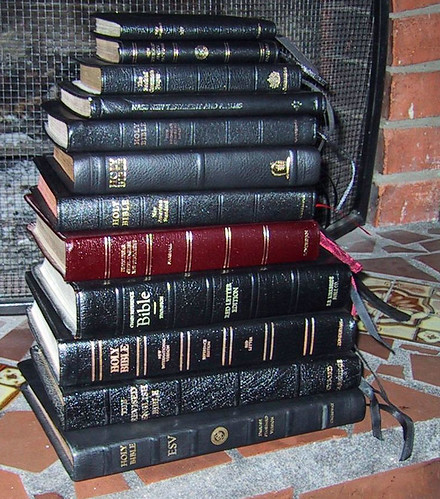
Sunday, October 19, 2008
Sorting out facts from conspiracy interpretations
The reason I'm saying this is not just to put down Scott Johnson but really more in the hope of heading off the disgust or discouragement some people may feel at some of what he says; that is, to encourage people to take his overall objectives seriously -- even taking some with a grain of salt when necessary -- and not give up because of his ignorance. God doesn't necessarily choose articulate educated people for His work, you know, and if only half of what he's talking about turns out to be true it's something the church should know about.
Some of it's pretty far out, such as the idea of an invasion of beings from "outer space" to "teach" the human race some things as part of the creation of the New World Order that will bring all humanity into subjugation to a single evil governing power. But there's enough evidence by now that some such scenario is a possibility. And what they're going to "teach" is what the New Age is already teaching, and what some "visionary" politicians also favor. Mostly socialism which is propagandized to be loving your neighbor. The Antichrist himself won't have anything more sophisticated to bring us than that in his chosen role as savior of the world, but he'll present it in pompous hifalutin terms and persecute anyone who dissents.
Take a look at some of the teachings of A Course in Miracles for an example of the kind of hifalutin mind-twisting stuff that "doctrines of demons" can amount to. They are meditation exercises with a sort of Buddhist tinge in places and a pseudo-Christian tinge as well, that open you up to a false view of Christ while they play with your mind and most likely bring demons into your life as you practice them, so that adepts may at some point demonstrate surprising supernatural abilities that would easily deceive people. Transcendental Meditation accomplishes the same thing by having a person meditate with a "sound" in the mind that can open up occultic experience, probably by summoning demonic influence. These comments are mostly from my own experience but this is the basic arena Scott Johnson is covering. The church does need to know these things.
If the church isn't prepared for some dazzling and intimidating signs and wonders we won't have a way to recognize their source and give a pointed answer to them as well as defend ourselves from them. Some of us have made a point to keep track of the New Age teachings for years anyway, usually those who have had some occultic experience on the way to becoming a Christian, as I did, but Christians who have had no such experience may be inclined to doubt the power in such things, so that when it finally manifests they may mistake it for God's work and be deceived for a time. This is the value of an overview like Scott Johnson's, as he is trying to cover all the possible scenarios that may arise as the last days come upon us.
So yes, it's all about a huge conspiracy, one with many tentacles, designed to captivate humanity to the devil's designs just as he did in Eden, but now with an eye to a spectacular finale that is most likely just around the corner. There are no doubt some people who are in on it, who have literally consciously sold their souls to the devil, but it's really the devil's ultimate work and the people are merely pawns. There is a kind of conspiracy thinking that sometimes goes along with it that attributes much more to the human players than seems warranted by the evidence. I especially cringe at the certainty of some of the people who are most into these things that EVERYBODY who has anything whatsoever to do with a particular political or economic development MUST be consciously complicit with the goal the writer is so certain about. There's quite a bit of this kind of thinking in last weekend's talk about the economy.
He says this entire election is a fraud, for instance. BOTH sides are in on this conspiracy to destroy the nation, he says. Perhaps they even know who is the winner before it comes about. So there's no point in voting for either one because both are evil. He doesn't give specifics in this case, just asserts it. He has given talks on Obama so what's evil about him in his mind is perhaps clear enough, but as far as I'm aware nothing has been said about McCain to support the suggestion that he's part of some huge conspiracy. I could see an argument not to vote for McCain based on his own voting record in the Senate, the positions he takes on the issues, but Johnson hasn't given any reason, he just asserts that McCain is evil too. (That is, what he's READING asserts it and he makes it clear he agrees. What Johnson does is read essays and articles he's chosen off the internet.)
He talks about President Bush as if he were evil personified. I'm sorry, I find it AWFULLY hard to see G W Bush as evil personified. I lost faith in Bush a long time ago, when he declared Islam a "religion of peace" and continued the "Road Map to Peace" policy which is such an unfair policy toward Israel, but I see that as political mistakes, not nefarious evil plotting to take over the world. Conspiracy thinkers don't seem to take into account that sometimes people make mistakes, that intentions go awry. You'd think they were all omniscient. It seems that if some decisions help to further an evil outcome of some sort -- at least an outcome they think is evil -- then there is no doubt in their mind that that outcome was intended in the decision itself. This is foolish thinking and I wish Johnson didn't indulge in it. He becomes untrustworthy in these areas.
I wanted to do some more research before getting into all this but something has to be said at this point and maybe I can research it later. For instance, at some site that Johnson quotes from there is a list of the supposedly bad spiritual fruit of George W. Bush that supposedly proves he's evil. I read it months ago and can't find it now but I remember thinking it was ridiculous. It's a list of bad decisions and mistakes at worst -- and some of that is a judgment call, it not being at all clear whether they even were bad decisions. You can't assume that because something has a certain result or means something in particular to you that it means the same thing to someone else, but this false kind of thinking is about all that list amounted to. I hope I find my way back to that page some time so I can be more accurate in my response to it.
One thing I do remember is that so much is made about the "cornuto" sign, the pointing of the index and little fingers. It's both a satanic sign indicating the devil's horns, and, much more commonly, the deaf sign word for "I love you." When there's a picture of George and Laura Bush making that sign, as there is at that link, it's absolutely ridiculous to suggest that they are consciously giving a satanic sign. It may be that for some people in SOME cases, but you CANNOT just assume it, you'd have to PROVE it; and in the case of the Bushes it is utterly ridiculous. Bush is not my favorite President by a long shot, and I do believe he and his father have been leading us into the One World Order, but I can only think of that as bad judgment, bad politics; I CANNOT think of him as a satanist. Good grief. I can't even think of his belonging to the infamous "Skull and Bones Society" as having any special significance in his case though the conspiracy thinkers imply all sorts of evil connected with that.
And since these conspiracy writers offer no evidence whatever it amounts to slander. The mere fact of the hand gesture, the mere fact of belonging to a society, the mere fact of sending troops to Iraq or whatever it is -- that's ALL they have for evidence of their own overwrought imputation of evil motivation to people.
Frankly, this is STUPID, and it doesn't help us sort out what is really going on in these last days.
Did Jesus call Pilate evil? He called Herod "that fox" but his strongest denunciations were never for the unbelieving world but for the religious leaders of his day. Paul always addressed the Roman authorities with respect.
Sure, it IS interesting to know the satanic meaning of the cornuto sign, because no doubt the devil is up to his eyeballs in its use even when people aren't using it consciously with his meanings.
It's also interesting to see that there does appear to be a Masonic layout to the city of Washington D.C., something I learned from a previous teaching of Johnson's, which certainly implies that SOMEBODY had a Masonic objective in mind in designing it, but isn't it possible that most of this stuff goes on without anybody's being the wiser, probably even most Masons? In any case, merely pointing out that the symbolism exists does NOT prove understanding of its full demonic meaning. George Washington was a pretty high level Mason they say, but can you tell from that that he had satanic motivations? And the Masonic symbols on the dollar bill. It really is interesting to recognize that and think about it. Very surprising how much Masonic influence there is in our national symbolism. But can you prove from those mere facts that the human beings who designed such things were really consciously complicit in their satanic meanings, or isn't it possible that most of them didn't really grasp the ultimate meanings of Masonry? Simply pointing out the symbolism doesn't in itself warrant such a conclusion. but this is ALL the evidence they seem to think they need. No, this can amount to slander, and the Lord will not overlook it. Such things are certainly suggestive that SOMETHING is going on that it would be good to know about, certainly some level of demonic influence, but conscious human complicity? That's going too far without more evidence than is typically given.
The idea that war is always for money is something else he also says in this talk about the economic collapse. He flatly states that everyone in power who sends men to war has money motivation. Oh really? That just sounds like the Leftist accusation, which is also a conspiracy theory. There is no proof that going to Iraq had any economic motivation. If it did, why are we suffering from high prices on oil? Why wouldn't we just take over their oil production for our own use? Such accusations are unwarranted. Did we go to Vietnam because of money interests? Korea? Second World War? I'm sure there are some who profit from war but sorry, overall this is just slander again. If there's one thing that makes America different from all history and the rest of the world it's that we DON'T go to war for purposes of conquest. I'm sure there are exceptions, possibly the Mexican-American War for instance (and that one may be bringing us God's judgment in the form of being flooded with illegal Latino immigrants), but the exception proves the rule as they say.
He even called Bush a madman, which almost made me laugh. The idea here is that we're being set up to be a police state as the US becomes part of the One World Order and since Bush has supposedly been plotting this throughout his term in office, he wouldn't like to have to give it up just at the very moment it looks like it's about to become reality, which the economic meltdown portends. So, since in a time of such dire national crisis a sitting President continues in office he wants to be sure he's the one presiding over the next developments in his plot and will do anything to make sure that neither Obama nor McCain take office. I don't care how wrong Bush has been about all kinds of things, I can't see the man as plotting the nefarious plots that Johnson is picking up from his sources. There has to be some room for simple character judgment. To call Bush a madman means the simple ability to read character has been warped. I think it's sin to say such things against a man that you can't prove, and he has NOT proved it. Sure, it's possible to misread character, but in Bush's case it's absurd to think what Johnson is saying. Now, Obama, that's another matter. I wouldn't put anything past him.
Isn't it possible for people to make mistakes? Certainly people can be complicit with the plans of the devil without being aware of it. The last days scenario is going to unfold as prophesied whether any human being has a conscious part in it or not. At this point there is, I hope, still time for many to be saved who are still under delusion.
Caveat: This post is just off the top of my head, based on my not-so-hot memory, so I may be misremembering things I'll need to correct later. I just felt something had to be said about this tendency to impute motivations without good evidence.
Saturday, October 18, 2008
The Antichrist. Revelation 13
¶ And I stood upon the sand of the sea, and saw a beast rise up out of the sea, having seven heads and ten horns, and upon his horns ten crowns, and upon his heads the name of blasphemy.
Re 13:2
And the beast which I saw was like unto a leopard, and his feet were as the feet of a bear, and his mouth as the mouth of a lion: and the dragon gave him his power, and his seat, and great authority.
Re 13:3
And I saw one of his heads as it were wounded to death; and his deadly wound was healed: and all the world wondered after the beast.
Re 13:4
And they worshipped the dragon which gave power unto the beast: and they worshipped the beast, saying, Who is like unto the beast? who is able to make war with him?
Re 13:5
And there was given unto him a mouth speaking great things and blasphemies; and power was given unto him to continue forty and two months.
Re 13:6
And he opened his mouth in blasphemy against God, to blaspheme his name, and his tabernacle, and them that dwell in heaven.
Re 13:7
And it was given unto him to make war with the saints, and to overcome them: and power was given him over all kindreds, and tongues, and nations.
Re 13:8
And all that dwell upon the earth shall worship him, whose names are not written in the book of life of the Lamb slain from the foundation of the world.
Re 13:9
If any man have an ear, let him hear.
Re 13:10
He that leadeth into captivity shall go into captivity: he that killeth with the sword must be killed with the sword. Here is the patience and the faith of the saints.
Re 13:11
¶ And I beheld another beast coming up out of the earth; and he had two horns like a lamb, and he spake as a dragon.
Re 13:12
And he exerciseth all the power of the first beast before him, and causeth the earth and them which dwell therein to worship the first beast, whose deadly wound was healed.
Re 13:13
And he doeth great wonders, so that he maketh fire come down from heaven on the earth in the sight of men,
Re 13:14
And deceiveth them that dwell on the earth by the means of those miracles which he had power to do in the sight of the beast; saying to them that dwell on the earth, that they should make an image to the beast, which had the wound by a sword, and did live.
Re 13:15
And he had power to give life unto the image of the beast, that the image of the beast should both speak, and cause that as many as would not worship the image of the beast should be killed.
Re 13:16
And he causeth all, both small and great, rich and poor, free and bond, to receive a mark in their right hand, or in their foreheads:
Re 13:17
And that no man might buy or sell, save he that had the mark, or the name of the beast, or the number of his name.
Re 13:18
Here is wisdom. Let him that hath understanding count the number of the beast: for it is the number of a man; and his number is Six hundred threescore and six.
Obama, Antichrist, Marxism, Fascism, Capitalism
Also, I got this from a friend this morning about why a Christian can't vote for Obama. The guy is already being harassed and threatened.
A friend posted on her blog that on Larry King a conservative called the Left Marxist and King shot back, if the Left is Marxist then is the Right Fascist?
That's a common line the Left likes to shoot at the Right, but it's false.
No, Fascism is government tyranny over the people. Marxism is ALSO Fascism. The thuggery being shown by some of Obama's supporters is fascist in spirit. If Obama were ordering it, that would make it Fascism on the level of Hitler.
If Obama is elected, Antichrist or not, the nation will soon be a police state.
Although the government's buying up debts is socialism, as some are complaining, it is also fascism. The first link above to Cutting Edge is where this article comes from, but I got it from one of Scott Johnson's PDF files:
Capitalism is that type of economy in which private individuals own the Means of Production, i.e., the factories and the mines. The companies founded by these private individuals then compete openly with one another in the Marketplace. No one tells the owners what to produce, or how much to produce, or how much to charge. Competition is the primary determinant of prices, and careful attention to the needs and wants of the people within this type of economy determines how much is produced. Capitalism may have its faults, but it has produced the highest standard of living in history for her citizens.
The key words underpinning Capitalism are: Free Market, Minimal Government Regulation, Business Ownership Solely By Private Interests.
Fascism is the economic system of Nazi Germany, National Socialist Italy, and Imperial Japan. Today, only Japan retains this system. In Fascism, private individuals retain control over the Means of Production, thereby ensuring that the key element which makes Capitalism work so well is kept in place.
However, the Government intervenes to control how much is produced of any item, how many competitors can be making the same item, and how much they can charge. Therefore, the potential for the most profit lies within the Fascist economy! The experiment with Nazi Germany and Imperial Japan proved that Fascism does work. We have seen that the proper coordination between Government and Capitalism does work.
The key words underpinning Fascism are: Severe Government Regulation, Government Control and Partial Ownership of Businesses Armed with this definition, you are now able to understand the importance of the events of this day.
Remember the key elements of Fascism as we examine these news articles: Government Control, Severe Regulation and Government Partial Ownership of Businesses.
The end result of this new global Fascist economy is the global economy foretold in Revelation 13:16-18!
Friday, October 17, 2008
More on Daniel Wallace Essay (5)
But before we look at these translations, I'd like to make three general comments. First, you might think there is no hope of ever knowing what the Word of God really says. There are so many translations that read so differently! How can anyone who does not know Greek or Hebrew really know what the Bible says?
Well, yes, this is exactly the effect of having so many different translations. The very fact of so many choices naturally raises the question, Which is the true Bible. At least Wallace acknowledges the effect, whereas James White didn't, but blamed the King-James-Only arguments for fostering mistrust of God's word. But then Wallace raises it only to dispense with it:
I am personally convinced that the Holy Spirit is sovereign over even the worst translations. Even in extremely biased or sectarian translations, all the major doctrines can be found. And if you know which translations are best, then you will be much better off! . . .The KJV translators also affirmed that even inferior translations are God's word, and that their work was only to make better what was already good, but they had far better cause for that position than the modern versions apologists have. There is no doubt that God makes use of the new versions for the salvation and guidance of many of His people, but that doesn't justify them.
Yes, it is much the same argument that since the major doctrines can be found in the new versions overall, the fact that those doctrines are nevertheless left out in many verses shouldn't be regarded as a problem. It's a spurious argument. What matters is whether the verses WERE left out, or conversely, added into the textual tradition on which the KJV is based. What matters, that is, is the TRUTH, keeping in mind that either subtracting or adding to God's word is a serious offense that is punishable by being cut out of the Book of Life.
So to make so much of the fact that the omnipotent and merciful God, who can speak to people through a burning bush or the mouth of a donkey or an unbeliever, can make use of a flawed translation as well, evades the question that matters: how is there any justification at all for so many translations, for the burden on the body of Christ to discriminate among them, even to play textual critics, and for the irreverence such human interference in God's work demonstrates?
Third, to the question "Which translation is best?", there can be no singular answer. I suggest that every Christian who is serious about studying the Bible own at least two translations. He should have at least one dynamic equivalence translation (or phrase-for-phrase) and one formal equivalence translation (that is, word-for-word translation). In fact, it would be good to have two dynamic equivalence translations--because in this type of translation, the translator is also the interpreter. If his interpretation is correct, it can only clarify the meaning of the text; if it is incorrect, then it only clarifies the interpretation of the translator!
This is pretty standard advice these days and I took it for granted myself until I began to see the problems with the modern versions. Now it strikes me as symptomatic of those problems. It really only makes sense if you accept the whole system of thought that supports the new versions. If you step back from it you have to wonder if it can be a good thing for the average Christian to be given the responsibility of choosing Bibles at all. For what purpose was the church given pastors, teachers, prophets, evangelists and so on except to take on certain tasks everyone in the body of Christ isn't gifted or called by God to pursue, such as ideally to provide a Spirit-inspired church-authorized Bible, done in the fear of God, for the whole body?
The unnecessary and distracting burden on the flock is one thing, but the very fact of many translations does erode trust in God's word, does place His word on a human footing which depreciates it in the public mind, however unconsciously, even encouraging in some the "liberal" attitude of putting their own judgment above God's word when they should submit to its judgment instead. There is really no excuse for the church's having accepted so many translations, or, of course, the original unauthorized revision in the first place.
Now, for the translations.
King James VersionFirst of all, it is misleading to put the King James on a list with the new versions as merely one of the many "translations," because that implies they are all translations of the same Greek and Hebrew text and obscures the fact that not only is the English different among the various Bibles even when the source text is identical, but the Greek and Hebrew texts themselves are different, and NOT merely minimally so.
The King James Bible has with good reason been termed, "the noblest monument of English prose" (RSV preface). Above all its rivals, the King James Version has had the greatest impact in shaping the English language. It is a literary masterpiece.
The King James is not simply one of the "versions," it is a completely different Bible based on a completely different set of Greek texts.
I also have to comment that to recognize that the King James had this enormous impact on the language, which it did, is to contradict that other claim Dr. Wallace made: that it needs to be changed to be accessible to the average person. No, obviously people adapted to the King James as the language did. The language grew in elegance and the people grew with it, and a good argument can be made that had it never been subjected to the tender ministrations of Westcott and Hort, the language, the culture and the church would continue to benefit.
There was probably reason even in 1881 to desire some revision for the sake of updating. Some will strenuously argue, not without some justification that should be taken seriously, that any updating at all was unnecessary and still is, but in any case there was no need at all for the extensive revision that was done instead. That revision amounts to a mutilation of the English, that very noble English prose that everyone always feels obliged to laud even while celebrating its eclipse by outrageously inferior substitutes. Someone who does that most likely has no genuine sense of the literary beauty of the King James anyway, but is only parroting the familiar testimony.
But, lest anyone wishes to revere it because it was "good enough for St. Paul," or some such nonsense, we must remember that the King James Bible of today is not the King James of 1611. It has undergone three revisions, incorporating more than 100,000 changes! Further, there are over 300 words in the King James that no longer mean what they meant in 1611. If one wishes to use a Bible that follows the same Greek and Hebrew texts as the King James, I recommend the New King James Version.2This is a common argument I've seen answered dozens of times though the mistake persists. It really holds no water.
There is a discussion of it at Way of Life. org but the link became obsolete after I quoted this:
It is true that there were revisions. The first was in 1629 by Samuel Ward and John Bois, who had worked on the original translation. The second was in 1638 by the Cambridge University Press. The third was in 1762 by Dr. Thomas Paris of Trinity College, Cambridge. The fourth was in 1769 by Dr. Benjamin Blayney.And The New King James is far from merely an updated King James. I myself used the New King James for years because it's represented as merely an updated King James, but it turned out it isn't a mere updating. It has been altered in many places to conform it to the revised Greek texts:
The changes, though, were of a very minor nature. They were largely a correction of printing errors, an updating of italics, spelling, and punctuation, and modernizing of some obsolete words. The changes also involved the addition of a large number of new marginal notes and cross-references.[Quoting Dr. Donald Waite] "There were ONLY 136 SUBSTANTIAL CHANGES that were different words. The others were only 285 MINOR CHANGES OF FORM ONLY. Of these 285 MINOR CHANGES, there are 214 VERY MINOR CHANGES such as 'towards' for 'toward'; 'burnt' for 'burned'; 'amongst' for 'among'; 'lift' for 'lifted'; and 'you' for 'ye.' These kinds of changes represent 214 out of the 285 minor changes of form only."
The instances in which the NKJV breaks with the original KJV by substituting wording identical to that of corrupted modern Bible versions are too numerous to be considered coincidence. And, since Nelson tells us that the NKJV scholars spent "months of prayer, research, and discussion over the handling of a single word," we must conclude that these changes were neither coincidental nor accidental.A long but not exhaustive list of such differences follows the above quote at the now-obsolete link, but it should be searchable at the site.
Dr. Cloud has other discussions of the problems with the NKJV at his site but links I post to specific pages on his site are always becoming obsolete. Just go to Way of Life dot org and search for the material which I'm sure is still there.
And here's a general answer to another essay by Dr. Wallace on the subject of the King James, Brandon Staggs' answer to Daniel Wallace: http://av1611.com/kjbp/articles/staggs-wallace.html
Wallace goes on to say that "300 words found in the KJV no longer bear the same meaning." While this is generally accurate, it is dishonest of Wallace to use this as a point of debate when his desire is to replace the KJV with a text based on entirely different manuscripts, not just to update thelanguage. Even the so-called New King James Version discards readings from the KJV and replaces them with different readings where no language updates are "needed." The "need" for an update is debatable, but is a different debate. So far, no suitable updates exist, because all of them change meanings of the text while claiming to merely update the words. Rather than tampering with the text, as no modern scholar seems able to do anything without changing the text, we'd be better off improving the vocabulary of Bible readers by a mere 300 words instead of shoveling them dozens of conflicting Bible versions and creating doubt in the process.
Wednesday, October 15, 2008
They've made up their minds and that is that.
Doing some research I found this quote I think deserves notice because it makes an observation that hits home with me as only too true, about the hostile state of mind of the new versions people. It's a pastor's testimony including how he came to recognize the problem with the Bible versions.
http://www.wayoflife.org/fbns/fbns/fbns60.html
"My knowledge on the state of the battle today is limited to my own small circle. For what it is worth, I SEE A REAL HOSTILITY THAT HAS BEEN GENERATED IN THE MINDS OF SOME OF THE YOUNGER PASTORS. There does not seem to be, on their part, a serious interest in dealing with this issue. It is better to let people make up their own minds. They, either willingly or ignorantly, see the issue as just a matter of translation. They think the newer versions read more smoothly. It doesn't seem to matter whether they are also accurate. It is the hostility, however, that is troubling. Sides are forming and deep prejudices are evident. To be 'a King James man' is now a term of opprobrium. This opposition is within 'so-called' evangelicalism, not as in the past, from the liberal-modernist camp. 'Truth is fallen in the street' "(Isa. 59:14; Jer. 5).
Yes, this topic feels like a war zone. He says his own knowledge is limited to his own circle, but you find this wherever you go on this topic. The new versions people mischaracterize KJV-onlies, misrepresent them as all irrational and lump them all in the same group with the real extremists like Peter Ruckman, without taking much care to distinguish different KJV advocates from each other. In any case they do not take their argument seriously. They impatiently toss out the party line and don't expect an answer they have to bother about and leave it at that. They don't have time to listen to the arguments. Nonexperts who are convinced will say they researched it (which amounts to having read James White's book and perhaps some other new versions advocates and maybe a bit of the KJV extremists), and that is the end of that.
And yes, it is all treated as a matter of translation and how well they think it reads. As with Daniel Wallace and James White, usually the KJV is listed along with all the new versions as just one of the many "translations" with their strengths and weaknesses, without any mention that the KJV is based on a different set of texts. Is this duplicity? Since they argue so strenuously for the Critical Text over the Received Text it's hard to believe they don't know they are misrepresenting the facts in doing this, but perhaps somehow in their own minds they really don't make the distinction most of the time.
Most of the arguments against the new versions are excellent, but few will listen.
Tuesday, October 14, 2008
More of the Daniel Wallace Essay (4)
III. Deissmann and the Papyri
In 1895 a German pastor by the name of Adolf Deissmann published a rather innocent-sounding volume: Bible Studies. Yet, this single volume started a revolution in NT scholarship--a revolution in which the common man was the winner.
In the 1800s Deissmann began reading ancient Greek MSS. But not the great classical authors. He was reading private letters, business transactions, receipts, marriage contracts. What were these documents? Merely scraps of papyrus (the ancient forerunner to paper) found in 2,000-year-old Egyptian garbage dumps. In these seemingly insignificant papyri, Deissmann discovered a key to uncover the NT! For these papyri contained the common Greek language of the first century A.D. They were written in the vocabulary of the NT.
What's so revolutionary about that? you ask. It is revolutionary because up until 1895, biblical scholars had no real parallels to the language of the NT. They often viewed its Greek as invented by the Holy Spirit. They called it "Holy Ghost Greek." Now it is true that the ideas--even the words--were inspired by the Holy Spirit. But it's another thing to say that the language of the NT was unusual--that its grammar and vocabulary were, in a word, unique. If this were true, only the spiritual elite could even hope to understand the NT.
Deismann's discovery burst the bubble on this view: the Greek of the NT was written in the language of the common man.
There are two implications of what Deissmann did for the Bible translations:
First, if the apostles wrote in easy-to-understand terms, then translations of the Bible should reflect this. We ought not to translate with big 50 cent religious-sounding words if the original was not written that way.
Except for having learned years ago that the Greek of the Bible is Koine Greek or the language of the common people, I'm not up on this facet of the situation and I guess I'll have to do some research, but my first take is that this seems like a trumped-up accusation of the KJV translators. Who says the KJV was written with "big 50 cent religious-sounding words?" What is the evidence that the KJV translators, or Tyndale or the Bishops Bible, which are about 95% of the KJV, did anything but render the Greek as accurately as possible? That is, since the Greek of the Bible is not identical to the Greek of the classics that educated people were familiar with, they may have erred in thinking it a special form of Greek invented by the Holy Spirit, but that doesn't mean they did anything but render it word for word as accurately as possible.
Well, he's going to give us an example of a "big 50 cent word" now:
The King James word 'propitiation,' for example, basically means 'satisfaction'--that is, God is satisfied with Christ's payment for our sins. Our Lord's final word from the cross, "It is finished," has been found on papyrus business documents--on receipts, if you will. It means "paid in full."1. Seems pretty obvious to me that "propitiation" is NOT well translated by "satisfaction." The online Merriam-Webster definition of propitiation is "Specifically an atoning sacrifice." "Satisfaction" is a very vague term compared to "propitiation." It waters down the meaning. "Appeasement" would be better than "satisfaction" but "propitiation" is the best because it is most accurate. If readers' vocabulary isn't big enough to take in "propitiation" then the Bible can teach them a word they need to know.
2. Comparisons of the different versions over and over have shown that the KJV does NOT have stilted words, but some of the modern versions do. Just think "pinions" in the Revised Standard and NASB's terrible rendering of Psalm 91 where the KJV has "feathers."
In other words, Bible translations need to be clear. One of the obvious proofs of this is that the gospel offends people. And it cannot be offensive unless it is understood!Yes, it DOES need to be clear, and "satisfaction" is NOT clear. It takes just as much explaining to get the meaning of "satisfaction" across as "propitiation" does, and it's open to far more misunderstandings.
As for offense, the idea of an atoning blood sacrifice of a human being is really offensive to people, but calling it payment of a debt is vague and wishy-washy and needs a lot of explanation.
Second, the papyri discoveries have helped us to understand words which the King James translators merely guessed at. For example, in the King James version of John 3:16, the Greek word translated 'only begotten' really means 'one and only' or 'unique.' The Bible, then, does not say that Jesus was the begotten Son of God--which might suggest that he had a beginning--but that he is the unique Son of God.
I assume this refers to the Greek word "monogenes" which the KJV and all the Bibles previous to it translated as "only-begotten?" Just looking at it suggests that has to be its most precise meaning. "Mono?" OK, pretty clearly means "one" or "only" (think "monogamy" or "monochrome" or "monologue.") Then "Genes" is obviously related to "genetics" and "generate" so "begotten" is apt for the origin of the Son of God. So in all these ordinary writings of daily life that Deissmann studied perhaps the most apt meaning is"unique or one and only." Well, are such writings normally referring to the generation of a human being, or simply the origin and uniqueness of various non-begotten things? Maybe I'm wrong but it sounds like it's a matter of context here, and in the mundane contexts in which the term monogenes was used it had to mean something like "unique" or "one and only" but that doesn't mean that in the context of the Biblical reference to the Son of God it is confined to that meaning.
As I already found out in doing verse comparisons, it appears that the differences in terms in the new versions usually come down to Westcott and Hort's having chosen the most marginally valid translation of the term, the least precise, or sometimes ANYTHING as long as the KJV didn't use it, and that subsequent versions based on the same Greek texts continued finding secondary and tertiary meanings for the Greek words. Really, that is the way it looks when you take the time to investigate and compare verses in many different translations, the word choices and what Strong's says about them.
But there is another implication of the papyri discoveries, though not related to Bible translations. Rather, it is related to preaching. Preachers of the Word of God need to make themselves understood. As one of my seminary professors was fond of saying, "We are not called to feed giraffes--we are called to feed sheep!" This does not mean that a sermon should be sloppy or inaccurate--just that it should be clear.
Deissmann has done a service for scholar and layman alike. He has shown that the language of the NT was understandable to the common man on the street. The ironic thing is that when the King James Bible was first published in 1611, it was condemned by many for being too easily understood! But after 400 years, the English language has changed. I, for one, invite the new translations because they give the gospel back to the people.
First of all, there is reason to believe that the new versions are not any clearer and have to be explained to people anyway.
Second, didn't Dr. Wallace just imply above that the King James used "big 50 cent words" and now he's pointing out that in its day it was thought to be "too easily understood!" There's something wrong with his reasoning here. Yes, after 400 years the English language has changed enough so that people do stumble over some of the archaic terms in the Bible. Remember though that in their day those archaic terms were not "big 50 cent words" but ordinary English.
Making the King James Bible accessible to people today only required at most some updating of some terms. There is absolutely no justification for substituting a whole different set of Greek texts and 36,000 changes in the English if your objective is to "give the gospel back to the people."
In fact there is no loss to the people of the gospel in the KJV as it now stands. It's mostly a matter of becoming familiar with it, which people were up to the time of Westcott and Hort, and would be now if it weren't for Westcott and Hort. There are very few words that cause people to stumble and they can be corrected in footnotes -- or if the revising committee that was hijacked by Westcott and Hort had done what they were in fact commissioned to do -- the absolute minimum necessary -- it would have been officially and sufficiently updated at that time.
Monday, October 13, 2008
More of the Daniel Wallace essay (3)
Third, the King James NT did not always follow the majority of MSS. Actually, the Greek text behind the King James was based on only about half a dozen MSS. Now it just so happened that these MSS belonged to the Byzantine text. But on a few occasions there were gaps. And the compiler (a man named Erasmus) had to fill in those gaps by translating the Latin NT back into Greek. There are, therefore, some readings in the King James--such as 'book of life' in Rev 22:19 or the wording of I John 5:7-8, which are not found either in the majority of MSS or the most ancient MSS. No serious student of the Bible would call them original (though many popular Bible teachers do).
Wycliffe English translation, 1388, has "book of lijf" at Rev. 22:19
Tyndale English translation, 1525-1535, has "boke of lyfe." (first English translation from the Greek.)
Bishops Bible, 1568, has "booke of lyfe"
Geneva Bible, 1587, has "Booke of life"
Dutch Statenvertaling, 1637, has "boek des levens." (tree of life is "boom des levens")
The above listing is simply to show that the KJV didn't come by its choice of "book of life" without precedent or authorization despite the paucity of Greek texts that have it. Why dismiss the Latin out of hand anyway? The translators obviously consciously chose it for whatever reason as the authentic rendering, and their reasons I would trust. It is known that the translators were familiar with all the texts available, they considered their choices with a high degree of precision, and had many others on the task to consult for each choice. Here's a place where the nonexpert can only trust the experts that show themselves to have the best qualifications, and to my mind that is the KJV translators far and away over Westcott and Hort and the other revisers of the liberally-corrupted 19th century they persuaded to their unjustifiable ways. Especially if the Greek texts the revisers based their choice on were only the Alexandrian type, the Latin of Erasmus is to be preferred. Of course it would be nice to see a comparison of all the extant Greek texts for this verse to know what Dr. Wallace means by "gap" in the Byzantine type. Is the whole phrase about taking the name out of the book of life not there?
And by the way, today's orthodox Jews acknowledge a Book of Life. Perhaps for some reason the early Gnostics didn't like the idea?
Fourth, the charge that the more ancient MSS or the men who embrace them are unorthodox is a faulty charge. It is true that in certain places the ancient MSS do not explicitly affirm the deity of Christ--such as in I Tim 3:16. But neither do they deny it!
No, there's no reason to accuse most of the new versions supporters of heresy just on that account. It seems pretty clear that most have simply been indoctrinated in the position of their schools, including acceptance of the basics of the Westcott and Hort travesty, ridicule of KJV-onlies and lack of encouragement to study the reasonable representatives of the anti-new versions position, especially Dean Burgon but some of the more recent writers too. Especially Dean Burgon. If ONLY Burgon were read, carefully thoroughly read.
As for the "more ancient MSS" the only important point is which are the closest to the originals, and simply being "more ancient" is far from guaranteeing that, and if the "more ancient MSS" aren't, then someone removed the affirmation of the deity of Christ in that verse as well as others.
Besides this, in some passages these ancient MSS make Christ's deity explicit where the King James does not! In John 1:18, the modern versions read "the unique one, God" while the King James has "the only begotten Son."
This is in fact the notorious "only-begotten God" passage. That is, the Greek in the "ancient MSS" (the corrupted MSS according to the authorities I trust) literally reads "only-begotten God" (as opposed to the Textus Receptus and KJV which have "only-begotten Son). Interestingly, the phrase is actually avoided in most of the translations, as well as by Dr. Wallace. Even Westcott and Hort avoided it in their Revised Edition, which Burgon notes and attempts to explain:
Thus we avow that we are offended at reading (against S. John i.18) -- 'Many very ancient authorities read "God only begotten:" whereas the 'authorities' alluded to read monogenes Theos [He gives the actual Greek which I am unable to reproduce here. The Textus Receptus has monogenes huios] . . . which (as the Revisionists are perfectly well aware) means 'the only-begotten God,' and no other thing. Why then did they not say so? Because (we answer) -- they were ashamed of the expression. --Dean John William Burgon, The Revision Revised, 1883, page 182.
Here's a site run by an independent Baptist church that answers this claim:
Interestingly enough, some have maintained that the “only begotten God” reading gives a stronger evidence to the deity of Christ since it uses the word “God”. Yet, the Jehovah Witnesses do not seem to think so. They fit it perfectly into their doctrinal system that denies the deity of Christ and makes Him a created “god”. In fact, as a whole, the Christian community did not like this reading. Despite other weaknesses, they saw it for what it was—an attack on the deity of Christ. To use an old saying, the “only begotten God” became about as rare in modern versions as hen’s teeth.
From the same site we have these facts too (I'm sure they're available from many sources, but they're here so I'm quoting him):
What exactly is the evidence against “the only begotten Son”? Sir Frederic Kenyon’s Handbook to the Textual Criticism of the New Testament gives credit for the departure from the Authorized Version of 1611 to the influence of the Codex Sinaiticus. This Greek manuscript was discovered by Constantin Tischendorf in 1844 in the Eastern Orthodox monastery of St. Katharine at the base of the traditional Mt. Sinai.
In fact, the United Bible Society’s Greek New Testament lists eight Greek texts that read the “only begotten god” though some manuscripts have a “the” and some do not. Yet, thirty-one listed manuscripts and a multitude of quotations from the early Christian authors attest to the King James reading of “only begotten Son”. The Sinaiticus, whose authority is definitive in this decision, is thought to be a product of the fourth century after Christ. Yet, at least two authors of the second century (Irenaeus and Clement) quote the passage as “the only begotten Son.”
[my emphases]
This is often the case with the evidence for the new versions choices over the KJV. Hard to justify rationally. Amazing to think that a huge swath of today's church accepts such stuff.
Wallace didn't quote it as "only-begotten God" but as "the unique one, God" -- perhaps for the same reason Burgon surmises was the case for Westcott and Hort, although the Greek in the corrupted texts quite straightforwardly reads "only-begotten God." Really, there doesn't seem to be any way to write this one that makes sense, let alone maintain the meaning of Christ as the begotten Son. Doesn't "the unique One, God" make that verse read "The unique One, God in the bosom of the Father has declared Him?" That doesn't even identify Christ at all. What exactly it means is impossible to say, though as noted in the quote above the JWs have no problem making it refer to a created god. Doesn't "only-begotten Son" convey the different Persons as well as the Deity of the Son? What am I missing?
But the American Standard, and Young's and Darby maintain the KJV's "only-begotten Son" and I haven't found any version that has "the unique One, God."
Others attempt to grapple with the new version in various awkward, confusing and ultimately meaningless ways:ESV: No one has ever seen God; the only God, who is at the Father's side, he has made him known.
NIV: 18 No one has ever seen God, but God the One and Only, who is at the Father's side, has made him known.
NASB: No one has seen God at any time; the only begotten God who is in the bosom of the Father, He has explained {Him.} [This is the only modern translation that uses the actual phrase given in the corrupted Greek texts.]
RSV: No one has ever seen God; the only Son, who is in the bosom of the Father, he has made him known.
When they don't refer to Christ or the Son at all, there is no way to make sense of the verse.
But here I have to say that as soon as I get into making comparisons like this I'm again appalled at the wildness that is accepted among Bible translations and allowed among Christians in dealing with God's word. I'm horrified. What? Anybody with a smattering of Greek or merely a Strong's Concordance and a Greek dictionary can have a go at it? What?
Futhermore, the majority of evangelical scholars embrace this critical text. Even the men who edited the New Scofield Reference Bible of the King James Version personally favor the critical text!Lots of fundamentalists have recently gone for the modern translations at least in part. It's a scandal among KJV-onlies. It's actually easy enough to explain as the leaven of the false versions spreading through the whole lump as scripture says leaven has a way of doing [1 Cor 5:6, Gal 5:9].
Fifth, at the same time, there are some scholars today who are strong advocates of the Byzantine text--most notably, Zane Hodges and Arthur Farstad. Together they edited The Greek New Testament According to the Majority Text and Dr. Farstad was also the senior editor of the New King James Bible. Thus, it is possible to be intelligent and still embrace the Byzantine text, just as it is possible to be evangelical and embrace the modern critical text. (I happen to disagree with the resultant text that Firsthad and Hodges have produced,1 but I respect their scholarship.)(Love that "possible to be intelligent and . . . ") If you really respected their scholarship you would present both sides of the argument as you go and make an attempt to show the superiority of your own against theirs, but so far this essay is nothing but the usual one-sided apologetic for the new versions argument.
Finally, we ought to quit labeling one another as heretics or idiots in the ongoing discussion. There needs to be charity on both sides. One of my college professors frequently said, "The Christian army is the only army in the world that shoots its wounded!" Unfortunately, this is especially true when it comes to translations of the Bible.Fine general principle, but a major help from the new versions side would be to stop characterizing all the KJV-onlies as extremists, conspiracy mongers and name-callers and actually address the substance of their argument.